Table of Contents
Biography
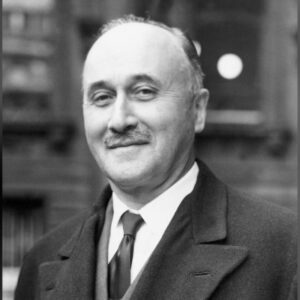
- Name:
Jean Monnet
- Born:
Cognac (France), November 9, 1888.
- Died:
Bazoches-sur-Guyonne (France), March 16, 1979.
- Important positions:
Deputy Secretary-General of the League of Nations (1919-1923), Commissioner of the French Plan Commission (1946-1952), President of the High Authority of the European Coal and Steel Community (1952-1955).
- Known for:
designing the proposal for the Schuman Declaration which led to the creation of the European Coal and Steel Community (ECSC), contributing to the process of European integration which gave birth to the European Union.
We explain who Jean Monnet was and the role he played in the history of the European Union. In addition, his reflections on post-World War II’s Europe.
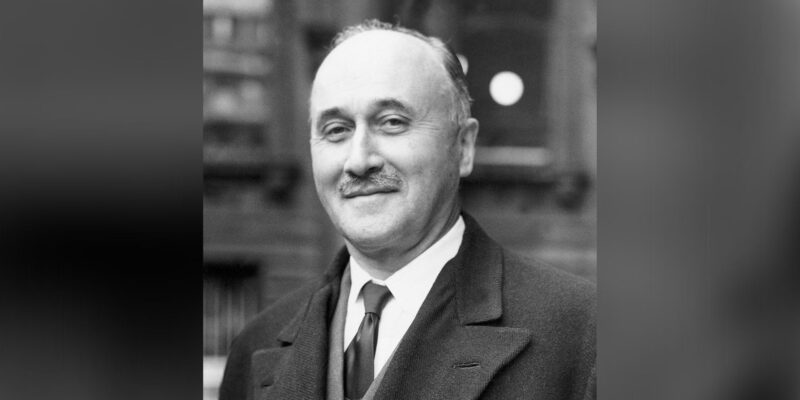
Who was Jean Monnet?
Jean Monnet was a French banker, politician and diplomat, born in Cognac on November 9, 1888, who played a major role in the process of economic integration leading to the birth of the European Union.
At the age of sixteen, he left France and traveled for study and business reasons to England, Scandinavia, Russia, Egypt, Canada, and the United States. He returned to France when World War I broke out in 1914 and proposed a plan to coordinate the military resources of France and the United Kingdom, believing this to be the only way to win the war. In 1917 he was a member of the Allied Maritime Transport Council.
After the war, he was Deputy Secretary-General of the League of Nations and, in the 1920s, he became one of the leading financial experts of the time and a partner at an American bank. In the 1930s, he served as advisor to Chinese President Chiang Kai-shek.
When World War II broke out, he persuaded Winston Churchill and Charles de Gaulle of the need to create a union between France and the United Kingdom. Following the war, he drew up a successful plan for the reconstruction and modernization of the French economy, known as the Monnet Plan.
On May 9, 1950, French Minister of Foreign Affairs Robert Schuman proposed a plan designed by Monnet, known as the Schuman Declaration, which called for the establishment of a French and German common market for coal and steel production. This led in 1951 to the establishment of the European Coal and Steel Community (ECSC), made up of France, West Germany, Italy, Luxembourg, Belgium, and the Netherlands.
Monnet became the first president of the ECSC’s High Authority, which came into force in 1952 and laid the foundation for the later European Economic Community. In 1955, he founded the Action Committee for the United States of Europe with the aim of fostering European integration through encouraging dialogue among political parties and unions.
In 1976, Monnet was bestowed Honorary Citizen of Europe. Three years later, on March 16, 1979, he died at the age of 90.
- See also: Lech Walesa
Jean Monnet’s reflections on the future
During World War II, Monnet became a member of the French Committee of National Liberation, the Free French government established in Argelia in 1943. During a committee meeting, he declared his reflections on the necessity of establishing a united Europe to ensure the peace and prosperity of its nations. Below is an excerpt of such reflections:
Algiers, 5 August 1943
(...) There will be no peace in Europe if the States are reconstituted on the basis of national sovereignty, with all that that entails in terms of prestige politics and economic protectionism (...). The countries of Europe are too small to guarantee their peoples the prosperity that modern conditions make possible and consequently necessary. They need larger markets.
(...) Prosperity for the States of Europe and the social developments that must go with it will only be possible if they form a federation or a ‘European entity’ that makes them into a common economic unit. (...)
Related articles:
Was this information useful to you?
Yes NoThank you for visiting us :)